By Meghan McCarthy
An Irish proverb says, “Aithnítear cara i gcruatán” — a friend is known in hardship.
For Norma “Momom” Hall, this rang true in the later years of her life as she lived with advanced dementia.
Momom grew up in picturesque Glenurla, Ireland, surrounded by lush green pastures and sweeping coastal cliffs. While breathtaking, the landscape held danger. As a child, Momom lost her beloved sister, Mary, in a tragic biking accident off one of those cliffs.
More than sisters, Momom and Mary were inseparable, best friends by all accounts. The loss shattered Momom. Yet, decades later, their bond reemerged in an unexpected way.
As Momom’s dementia progressed, she began talking to someone who wasn’t there. At first, it startled her family.
“Momom’s dementia escalated quite rapidly,” her granddaughter, Olivia, explained. “At first she just understood herself to be living in the Ireland of her youth. In time, she started talking over her shoulder about a woman, who she referred to as Mary. After a few weeks, Momom started to refer to the woman on her shoulder as Mary.
Though Momom was hallucinating, her experience wasn’t frightening. Instead, it brought comfort and companionship. She spoke with Mary as though she were right beside her, sharing jokes, telling stories, laughing as they once did.
In losing her memory, Momom had regained her sister.
Understanding Hallucinations in Dementia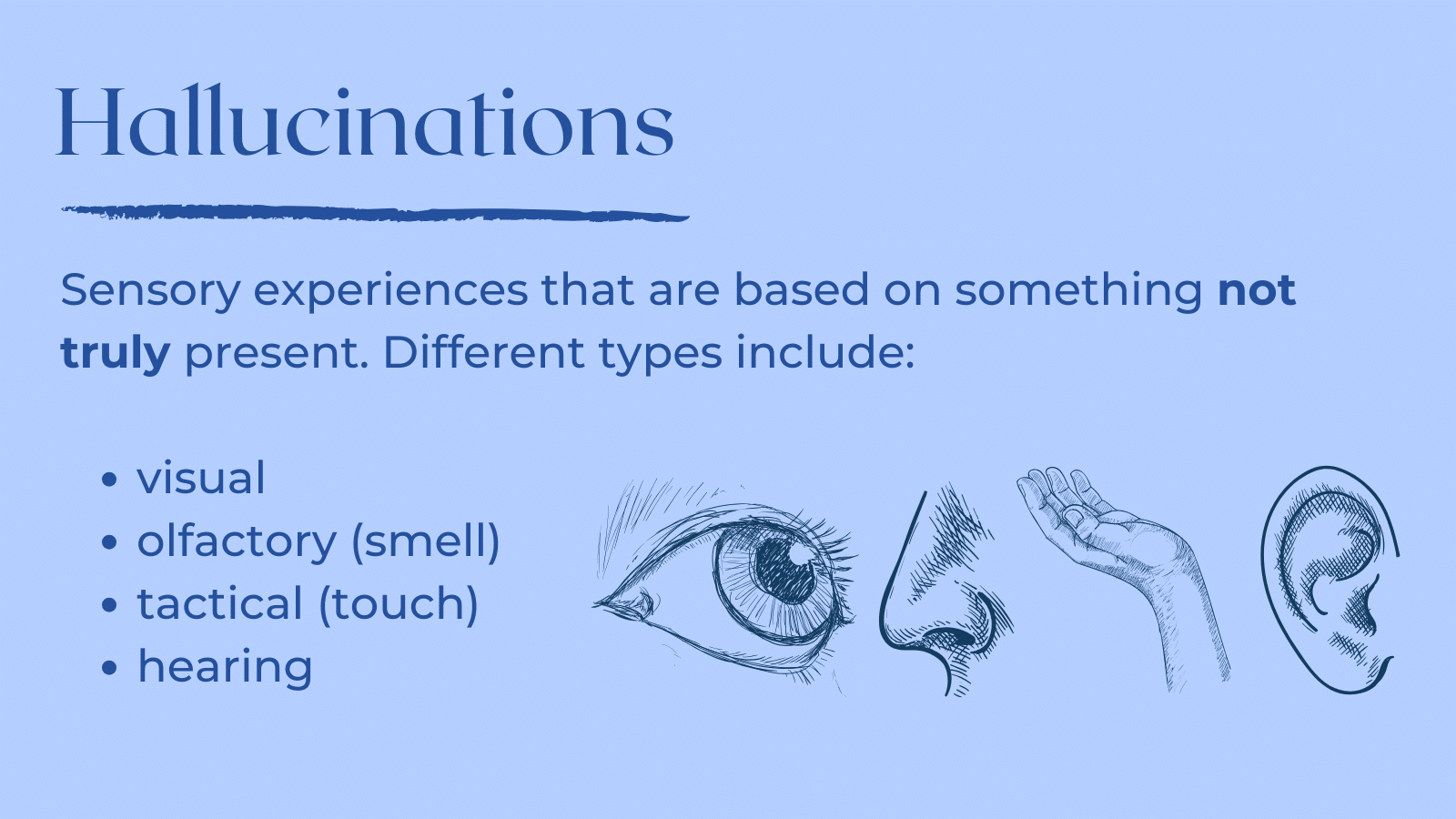
Hallucinations are sensory experiences that do not correspond to reality. They can be visual, auditory, olfactory (smell), or tactile (touch).
Up to 50 percent of patients with late-stage Alzheimer’s disease or related dementias (ADRDs) experience hallucinations. While visual hallucinations are the most common, the type and frequency can depend on the specific diagnosis.
For example, hallucinations often appear earlier in patients with Lewy body dementia (LBD), and those patients might even retain awareness that their experiences are not real. In patients with vascular dementia, the location of brain damage can influence the type of hallucinations.
Many caregivers confuse hallucinations with delusions, but they are distinct.
“While hallucinations are derived from a sensory experience, delusions are false beliefs,” explained Bianca Cavedoni-Urbano, MD, former clinical fellow at Penn Memory Center (PMC). “Delusions are an idea, or fixed thought, that people can have that is based on a fake idea. These a concerning because they can create a conflict in the relationship between a patient and caregiver.”
Common delusions in dementia include:
- Paranoid delusions: for example, believing caregivers or staff are stealing
- Duplicative delusions: like a person or a place is duplicated and exists in two or more places at the same time
- Capgras syndrome: such as believing loved ones have been replaced by look-alikes imposters.

What causes hallucinations?
While neurodegeneration is the primary cause, other factors can trigger or worsen hallucinations.
Not wearing glasses or hearing aids can deprive the brain of sensory input, leading to hallucinations. Overstimulation, such as in noisy or crowded environments, can also be a factor. Another common trigger is delirium, which may result from infections or other medical issues.
Managing Hallucinations with Empathy
While watching a loved one experience hallucinations can be incredibly upsetting, Dr. Cavedoni-Urbano emphasizes that the emotional response of the patient is key to determining the best course of action.
Medications used to treat hallucinations, often antipsychotics, carry significant side effects, including an increased risk for cardiovascular events like stroke or heart attack.
“With families, we focus on providing support and assessing whether there is a stress or risk that results from the hallucinations,” Dr. Cavedoni-Urbano said. “While some antipsychotics are relatively safe, we try to avoid undesired side effects as possible.
Instead, families are encouraged to support their loved one through empathetic communication.
Alison Lynn, MSW, LCSW, PMC director of social work, frequently works with care partners to help them navigate these situations. Her core advice: Don’t try to reorient the patient to your reality. Instead, meet them in theirs.
She recommends a three-step approach:
- Understand the experience that a loved one shared.
“Ok, I hear you. You see _______, is that right?”
- Validate: their emotions and experiences.
“I believe you, how are you feeling?”
- Reassure: their loved one that they are safe and secure.
“I will help keep you safe.” or “You are safe with me.”

“Even if someone is distressed, don’t argue about whether their experience is real,” Lynn said.
Each patient has unique triggers that can preempt a hallucination. Families can work with their social work and clinician team to identify triggers and make modifications. Similarly, after a hallucination has occurred, Lynn recommends trying to redirect the patient to soothe someone’s anxiety if hallucinations are distressing. For example, playing music or moving into a new environment can work for some patients.
But when they do happen, caregivers should try not to panic or blame themselves.
“While this is a ‘normal’ part of many diseases that cause dementia, it is very upsetting for families and caregivers,” Lynn said. “Do not despair if you are not able to immediately enter that person’s reality. It takes building a threshold and practice.”
Dr. Cavedoni-Urbano agrees.
“As we work with families, we help them understand that this is part of the process, no one needs to feel guilt or blame,” she said. “Often, care partners feel responsible for any discomfort. The reality is they don’t have control over what is happening in the brain of their loved one.”
A Friend in Hardship
Momom’s story is a powerful reminder that not all hallucinations are frightening.
In her reality, her dearest childhood friend had returned to keep her company through the fog of memory loss. Momom found comfort — not alone, but with Mary by her side once again.
“We saw how much Momom relied on Mary’s presence,” her granddaughter, Olivia, shared. “She helped her to make sense of her new world, giving constant companionship and support when Momom needed it most. So, we embraced Mary, and thanked Momom’s sister for having been that source of love and steadiness in both her young adult and senior life.”
